The best Strix Halo mini PCs (Ryzen AI Max+ 395), researched
Our researched ranking of the four Strix Halo mini PCs we cover — Geekom A9 Mega, GMKtec EVO-X2, Minisforum MS-S1 Max and Beelink GTR9 Pro — with prices, specs and third-party test figures.
Geekom A9 Mega at $3,799 is the Strix Halo mini PC we would buy, for a balanced single-user local AI workstation with the memory and expansion most buyers need. GMKtec EVO-X2 ($3,649.99) is the pick if the same model fits at a lower total cost. Minisforum MS-S1 Max ($3,799) is for infrastructure buyers who need fast networking and internal expansion. Beelink GTR9 Pro ($4,349) is the premium network configuration. All four run the same AMD Ryzen AI Max+ 395 chip, but their memory, storage, ports and cooling are not identical.
01 — Best overall
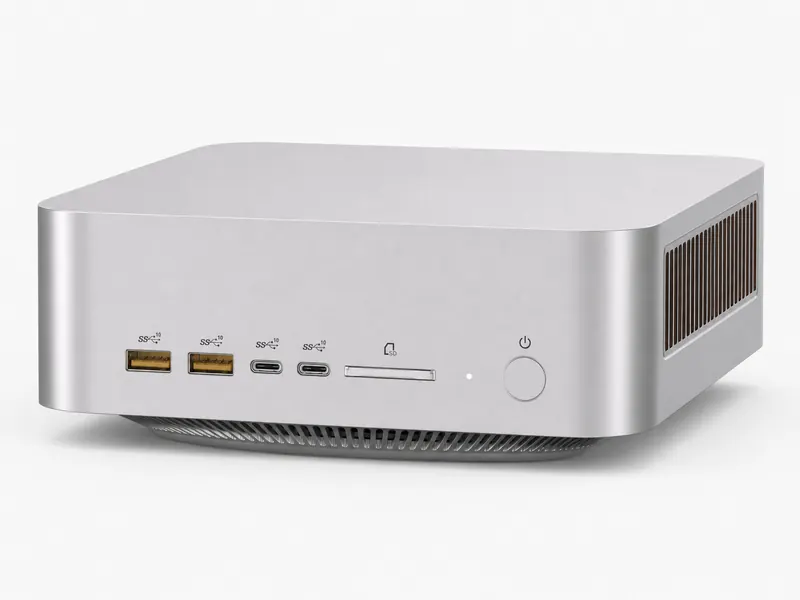
Geekom A9 Mega
8.0/10
Price
$3,799
Type
Ryzen AI Max+ 395
Assessment
Researched
Geekom A9 Mega is our pick for a single-user Strix Halo workstation. It pairs the Ryzen AI Max+ 395 with the memory capacity and expansion most local AI buyers need, and its $3,799 price undercuts the Beelink GTR9 Pro by $550. The GMKtec EVO-X2 carries a slightly higher draft score (8.2) at a lower price, but the A9 Mega's balance of memory, expansion and price is what keeps it our overall pick. This is a researched verdict, not a hands-on ranking: no Testbench Lab measurements back it yet.
Choose it if: You want one balanced Ryzen AI Max+ 395 box for local AI and everyday workstation use.
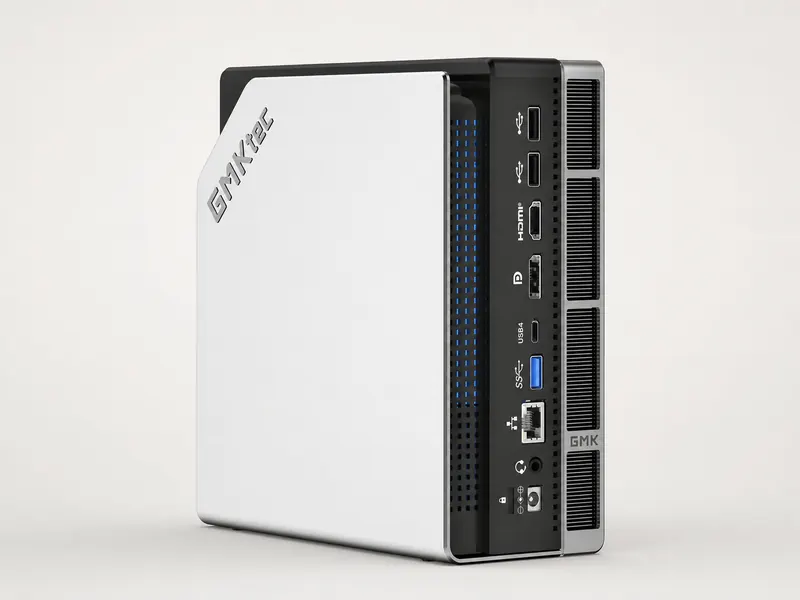
GMKtec EVO-X2 is the cheapest of the four at $3,649.99, $149.01 below the Geekom A9 Mega. It is the one Strix Halo mini PC with a published side-by-side benchmark: Dave's Garage measured 32,541 in Cinebench R23 multi-core on 20 August 2025, against 33,935 for the Framework Desktop and 36,012 for the HP Z2 Mini G1a — a spread that shows the same chip performs differently in different chassis. That test also recorded EVO-X2 CPU temperatures of 90–95 °C under load, so check the full review before buying for sustained workloads.
Choose it if: You want the same chip at the lowest price and the model you run fits its configuration.
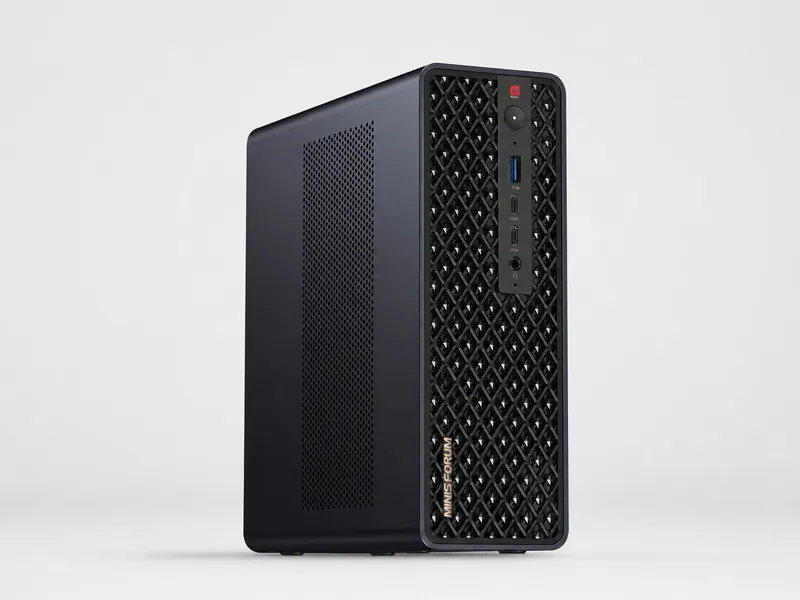
Minisforum MS-S1 Max serves buyers who can use fast networking and internal expansion, at the same $3,799 as the Geekom A9 Mega. ComputingForGeeks' 30 September 2026 roundup compared it with the EVO-X2 and GTR9 Pro on price, ports and 10GbE, and found the networking and expansion options are where these boxes genuinely differ. Treat those as workload features, not extras.
Choose it if: You need 10GbE-class networking, internal expansion or a box that fits server-style use.
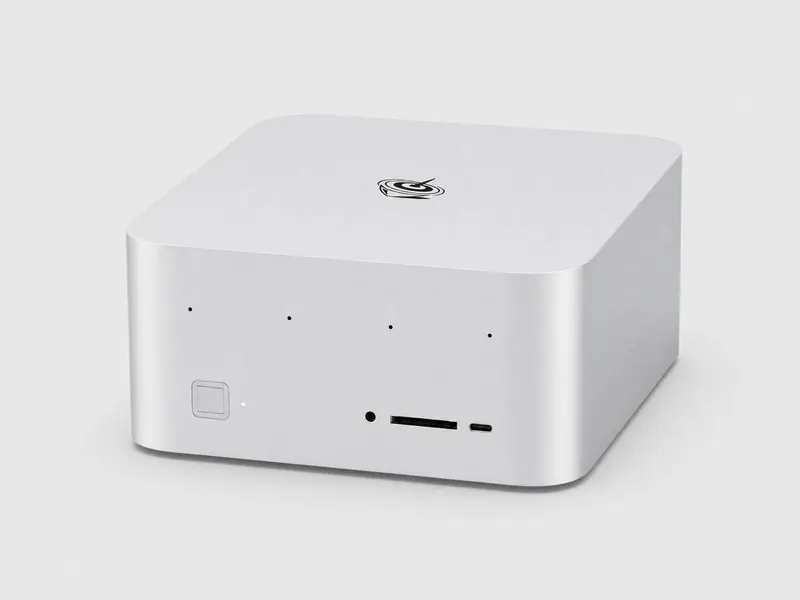
Beelink GTR9 Pro is worth checking when a specific interface or premium network package determines the purchase, and it is the only one of the four above $4,000. Verify the exact board, memory and seller terms before buying, because the Max+ 395 chip alone does not justify the $550 premium over the Geekom A9 Mega. The Geekom A9 Mega remains our overall pick, while recognising that a necessary interface can determine the purchase.
Choose it if: You need the exact port or network package only the GTR9 Pro offers.
These picks are a researched assessment, not hands-on rankings: Testbench Lab has not yet run the four machines through its mini PC test brief. The picks rest on manufacturer specifications (labelled as advertised), US store prices checked 2 October 2026, and four third-party roundups and tests found on 1 October 2026: ComputingForGeeks (30 September 2026), Local AI Master (16 August 2026), Memeburn (11 September 2026) and Dave's Garage (20 August 2025). Most existing roundups pull their LLM, noise and power numbers from ServeTheHome and community runs rather than testing the machines themselves; only Dave's Garage measured several units side by side. Where a figure is third-party, the page names who measured it and when. Scores are draft editorial ratings out of 10 for David Wilson to confirm.
Which Strix Halo mini PC is the best?
Geekom A9 Mega at $3,799 is our overall pick among Strix Halo mini PCs. That is a researched verdict from specifications, prices and third-party tests, not a hands-on ranking of the four machines in our lab.
The reason the pick is not obvious is that all four products on this page run the same chip: the AMD Ryzen AI Max+ 395, the "Strix Halo" part with 16 Zen 5 cores and a large unified memory pool shared between CPU and integrated Radeon 8060S graphics. The chip is explained in ryzen ai max 395. What separates the boxes is everything around it: memory capacity and speed, storage, ports, networking, cooling and price. Two machines with the same chip can differ in sustained performance, as the one published side-by-side test of Strix Halo boxes shows — Dave's Garage's 20 August 2025 video measured a roughly 10% Cinebench R23 multi-core spread between three Max+ 395 machines, covered in full below.
Product
Price (2 Oct 2026)
Our score
Award
Geekom A9 Mega
$3,799
8.0
Best overall
GMKtec EVO-X2
$3,649.99
8.2
Best matched lower-cost offer
Minisforum MS-S1 Max
$3,799
8.0
Best for infrastructure
Beelink GTR9 Pro
$4,349
7.8
Best premium network configuration
The Geekom A9 Mega wins on balance. It matches the Minisforum MS-S1 Max on price, sits $149.01 above the GMKtec EVO-X2, and costs $550 less than the Beelink GTR9 Pro, while covering the memory and expansion a single-user local AI workstation needs. The GMKtec EVO-X2 carries the highest draft score of the four at 8.2, but the published evidence does not separate the boxes on measured performance, so the overall pick rests on the A9 Mega's configuration balance rather than on a score alone. Before buying any of them, check the exact processor variant and installed memory on the specific listing, then confirm that your model runner can use the allocation. The full case is in the geekom a9 mega review.
The right alternative depends on matched memory, expansion and network needs. The Max+ 395 chip shared by all four does not make their complete configurations identical. Capacity selected at purchase is especially important because this class uses onboard memory — you cannot add more later the way you can in a desktop with memory slots. A buyer who underspecifies at checkout has no upgrade path except a new machine.
That is also why the price ladder matters less than it looks. The gap between the cheapest and most expensive pick is $699.01, from $3,649.99 to $4,349. Against a $3,700–$4,300 purchase, a $149.01 saving is not worth a configuration that cannot hold the model you actually run. Buy the configuration first, the price second. And a smaller-capacity bargain can become the wrong purchase if the model you want leaves too little room for context: the model weights, the key-value cache for your context length and the operating system all draw from the same pool.
Who makes Strix Halo mini PCs?
Several manufacturers make Strix Halo mini PCs; our shortlist covers Geekom A9 Mega, GMKtec EVO-X2, Minisforum MS-S1 Max and Beelink GTR9 Pro, and they are not the only ones.
Third-party roundups cover a wider field. ComputingForGeeks' 30 September 2026 comparison of five Ryzen AI Max+ 395 machines included the Framework Desktop, the Bosgame M5 and the MS-S1 Max alongside the EVO-X2 and GTR9 Pro. Local AI Master's 16 August 2026 roundup covered six boxes, adding the HP Z2 Mini G1a and AMD's own Halo development system. Memeburn's 11 September 2026 roundup cast the net wider still, including Corsair and Apple Mac mini machines as local AI alternatives.
Maker
Machine
On our site?
Geekom
A9 Mega
Yes — pick
GMKtec
EVO-X2
Yes — pick
Minisforum
MS-S1 Max
Yes — pick
Beelink
GTR9 Pro
Yes — pick
Framework
Desktop
No; covered by ComputingForGeeks, Local AI Master, Memeburn, Dave's Garage
HP
Z2 Mini G1a
No; covered by Local AI Master, Memeburn, Dave's Garage
Bosgame
M5
No; covered by ComputingForGeeks
AMD
Halo development system
No; covered by Local AI Master
We do not yet review the Framework Desktop, HP Z2 Mini G1a or Bosgame M5, so they are not ranked here. But they matter as evidence: the HP Z2 Mini G1a and Framework Desktop both appear in the only side-by-side measurement we found, Dave's Garage's 20 August 2025 video test, discussed below. AMD's own development system is a reference platform rather than a consumer product, which is why the roundups treat it as a baseline rather than a purchase.
Within our four, the makers are established mini PC brands: Geekom, GMKtec, Minisforum and Beelink. Each sells through its own store; the prices in this page's tables are the manufacturer's listed US prices checked 2 October 2026, without discount codes. Re-check the price on the day you buy, and check the seller terms on the specific configuration — especially for the Beelink GTR9 Pro, where the board and memory package on offer should be verified before purchase.
How fast are Strix Halo mini PCs for local AI?
Strix Halo mini PCs run large local models at speeds third-party testers place in a consistent band, with the differences between boxes smaller than the differences between models and settings.
Local AI Master's 16 August 2026 roundup, citing ServeTheHome figures, reports gpt-oss-120b at about 45 tok/s and all the Strix Halo boxes it covered in a 30–45 tok/s band. Memeburn's 11 September 2026 roundup cites dense 70B models at about 4–6 tok/s and 120B mixture-of-experts models at 31–55 tok/s. ComputingForGeeks' 30 September 2026 comparison cites tokens-per-second figures taken from ServeTheHome, CraftRigs and llama.cpp community runs rather than its own measurements.
Model type
Reported speed
Source
120B MoE (e.g. gpt-oss-120b)
30–55 tok/s
Local AI Master (16 Aug 2026), Memeburn (11 Sep 2026)
Dense 70B
about 4–6 tok/s
Memeburn (11 Sep 2026)
These are aggregated third-party figures, not Testbench Lab measurements, and none of the three roundups tested all four of our picks side by side. Note what the two rows mean in practice. A 120B mixture-of-experts model activates only a fraction of its parameters per token, which is why it runs an order of magnitude faster than a dense 70B model despite being larger. A dense 70B at 4–6 tok/s is usable for batch summarisation and slow for interactive chat; a 120B MoE at 30–55 tok/s feels responsive. If a seller quotes a tokens-per-second figure without naming the model class, the number is close to meaningless.
The practical reading: the Max+ 395's large unified memory is what makes the 120B class fit at all, and the chassis you choose changes the result less than the model, quantisation and context settings do. That is why the four machines on this page cluster in one performance band rather than separating cleanly. It is also why our ranking rests on configuration, price and features rather than on throughput claims: within a 30–55 tok/s band, the published evidence does not separate the boxes.
That is also why we say match configurations before comparing results. Use the same model, quantisation, context and backend. Record memory allocation and power mode. Without those conditions, a tokens-per-second figure is a result for one setup, rather than a reliable rank for the chassis. How much memory a given model needs is covered in how much RAM do you need to run a local LLM.
Is Strix Halo good for gaming?
Strix Halo is good for gaming at integrated-graphics settings, and its larger integrated graphics platform — the Radeon 8060S — is the reason, but settings, memory allocation and shared power limits still determine the result.
The Radeon 8060S is a step up from the Radeon 890M found in lower-tier Ryzen AI mini PCs, and it shares the same unified memory pool as the CPU. That helps in games that scale with memory bandwidth and allocation. But because the GPU draws from the same power budget and memory as the CPU, a heavy background workload or a large model loaded into memory changes gaming performance. A machine running a local model is not the same machine, thermally or performance-wise, as the same machine at idle. Buyers who want the detail should read radeon 890m vs radeon 8060s.
None of our four third-party sources published game benchmarks for these machines. Their focus is local AI, which is also these boxes' reason to exist: a discrete GPU of similar capability costs less than a $3,649.99–$4,349 Strix Halo system if gaming is the only goal. Buy a Strix Halo mini PC for the combination of local AI memory capacity and competent integrated gaming, not for gaming alone. If gaming is the primary use and local AI is a maybe, the Max+ 395 is paying for memory you will not use.
The one measured performance comparison we found, Dave's Garage's 20 August 2025 video, tested CPU and thermals rather than games: Cinebench R23 multi-core scores of 36,012 for the HP Z2 Mini G1a, 33,935 for the Framework Desktop and 32,541 for the GMKtec EVO-X2. That roughly 10% spread on the same chip shows why the box matters — and why gaming claims without settings and memory allocation attached should be treated as anecdotes. The same video recorded EVO-X2 CPU temperatures of 90–95 °C under load, a reminder that sustained performance in a small chassis depends on cooling, not just on the chip.
What is Strix Halo equivalent to?
There is no single universal desktop-GPU equivalent to Strix Halo; workload, power and memory behaviour change the comparison.
For local AI, the closest thing to an equivalence is memory capacity. A Max+ 395 system with a large unified memory pool can load models that would need a desktop GPU with correspondingly large VRAM — but it runs them slower, because shared memory bandwidth is not graphics-card VRAM bandwidth. The dense 70B and 120B MoE figures above are the honest shape of that trade: big models fit and run at usable speeds, not at flagship-GPU speeds. That trade is the whole reason these machines exist at their prices, and it is also the reason a desktop-GPU buyer who does not need the memory may be happier elsewhere.
For CPU work, Dave's Garage's 20 August 2025 Cinebench R23 numbers give a concrete reference: 32,541–36,012 multi-core across three Strix Halo boxes. Treat that as a CPU-class indicator, not a translation into GPU terms. For context on what the platform is and is not, read ryzen ai max 395, and for the memory architecture behind the AI story, what is unified memory.
The other common comparison is NVIDIA's DGX Spark, a small local AI machine in the same price class. That comparison has its own page: nvidia dgx spark vs strix halo mini pcs. In short, treat "equivalent to" questions as workload questions. Name the model, the quantisation and the budget, and the equivalence answers itself. A buyer running 120B MoE models will get one answer; a buyer rendering video will get another; a buyer who mainly games will get a third.
What to match before comparing results
Match the model, quantisation, context and backend before you treat any Strix Halo benchmark as a ranking; memory allocation and power mode matter as much as the chassis.
This is the single biggest weakness in the published coverage of these machines. ComputingForGeeks, Local AI Master and Memeburn all cite tokens-per-second figures that trace back to ServeTheHome and community runs, not to their own testing on matched settings. Dave's Garage measured three machines side by side, but on Cinebench and thermals, not on LLM throughput, and it excluded the MS-S1 Max, GTR9 Pro and A9 Mega entirely.
Source
Date
What it measured
What it did not
ComputingForGeeks
30 Sep 2026
Price, ports, 10GbE, noise across 5 boxes
No first-party tokens/sec, dBA or power
Local AI Master
16 Aug 2026
6 boxes, STH-cited throughput
No own testing, no noise figures
Memeburn
11 Sep 2026
Throughput bands across 8+ machines
No dBA or wall-power figures
Dave's Garage
20 Aug 2025
Cinebench R23, thermals, subjective noise on 3 boxes
No dBA meter or wall power; excluded 3 of our 4 picks
So when a seller or a forum post quotes a tokens-per-second figure, ask: which model, which quantisation, what context length, which backend, how much memory allocated to the GPU, and what power mode. Record those with your own runs. A same-bench, same-settings comparison across these four machines — tokens/sec on dense and MoE models, dBA and wall power per unit — is exactly what Testbench Lab's mini PC test brief sets out, and it is the clearest opening in this category. Until those runs exist, our ranking rests on specifications, prices and the third-party evidence above.
Dave's Garage's thermals are the one caution flag worth repeating: the EVO-X2 ran at 90–95 °C under load in that test, and the reviewer judged the Framework Desktop the quietest of the three. Neither figure is a Testbench Lab measurement — the video used no dBA meter — but both argue for checking cooling and noise in the gmktec evo-x2 review before buying that box for sustained workloads. A machine that reaches 90–95 °C in a Cinebench run may throttle or run its fans harder during an hours-long model session, and neither outcome shows up in a tokens-per-second headline.
The same discipline applies to power figures. None of the four sources measured wall power; Local AI Master and Memeburn took power from spec sheets and ServeTheHome. If your buying decision depends on power draw — a always-on home server, a clustered setup, an office with limited circuit capacity — treat every published figure as an estimate until you measure the machine you bought, in your configuration, at your workload.
How do the four Strix Halo mini PCs compare directly?
The four Strix Halo mini PCs differ mainly on price, networking and expansion, and our three head-to-head pages break those differences out pair by pair.
The pattern across the four: the GMKtec EVO-X2 is the value entry at $3,649.99; the Geekom A9 Mega and Minisforum MS-S1 Max tie on price at $3,799 with different strengths; and the Beelink GTR9 Pro asks $4,349 for a premium network configuration. ComputingForGeeks' 30 September 2026 comparison of ports and 10GbE across several of these machines is the best published starting point for the networking differences.
The two same-price machines split cleanly by buyer. The Geekom A9 Mega is the single-user workstation: one person, one desk, local models and everyday work. The Minisforum MS-S1 Max is the infrastructure box: fast networking and internal expansion treated as workload features. An additional network interface cannot make a model fit into insufficient memory, and clustering requires appropriate software — so buy the MS-S1 Max for what its expansion enables, not in the hope that ports add performance.
The Beelink GTR9 Pro is the odd one out on price. At $4,349 it is $550 above the Geekom A9 Mega and $699.01 above the GMKtec EVO-X2, and the shared Max+ 395 chip does not by itself justify that gap. What can justify it is a specific interface or network package that only the GTR9 Pro offers and that your setup requires. Verify the actual board and seller terms before you pay the premium.
Geekom A9 Mega ($3,799) is our overall pick for a general local AI workstation. GMKtec EVO-X2 is the cheaper option at $3,649.99, Minisforum MS-S1 Max suits infrastructure buyers at the same $3,799, and Beelink GTR9 Pro is the premium network configuration at $4,349. This is a researched ranking, not a lab measurement.
Who makes Strix Halo mini PCs?
Geekom, GMKtec, Minisforum and Beelink make the four Strix Halo mini PCs we cover, and others including Framework, HP, Bosgame and AMD's own development system exist. Third-party roundups from ComputingForGeeks, Local AI Master and Memeburn (August–September 2026) cover the wider field.
Is Strix Halo good for gaming?
Yes, at integrated-graphics settings, thanks to its Radeon 8060S graphics and large unified memory. But settings, memory allocation and shared power limits determine the result, and no published test we found benchmarks games on these machines. Buy Strix Halo for local AI first; gaming is a secondary benefit.
What is Strix Halo equivalent to?
There is no single desktop-GPU equivalent. For local AI, its large unified memory lets it load models that would need a big-VRAM desktop GPU, but run them slower. For CPU work, Dave's Garage (20 August 2025) measured Cinebench R23 multi-core scores of 32,541–36,012 across three Strix Halo boxes. Workload, power and memory behaviour change the comparison.
[9]Dave's Garage: 128GB AI PC Showdown (YouTube) — Side-by-side test of HP Z2 G1a, Framework Desktop and EVO-X2: Cinebench R23 multi 36,012 / 33,935 / 32,541; EVO-X2 thermals 90–95 °C; Framework judged quietest. Published 20 August 2025. No dBA or wall-power readings; excludes MS-S1 Max, GTR9 Pro and A9 Mega. Read 1 October 2026.